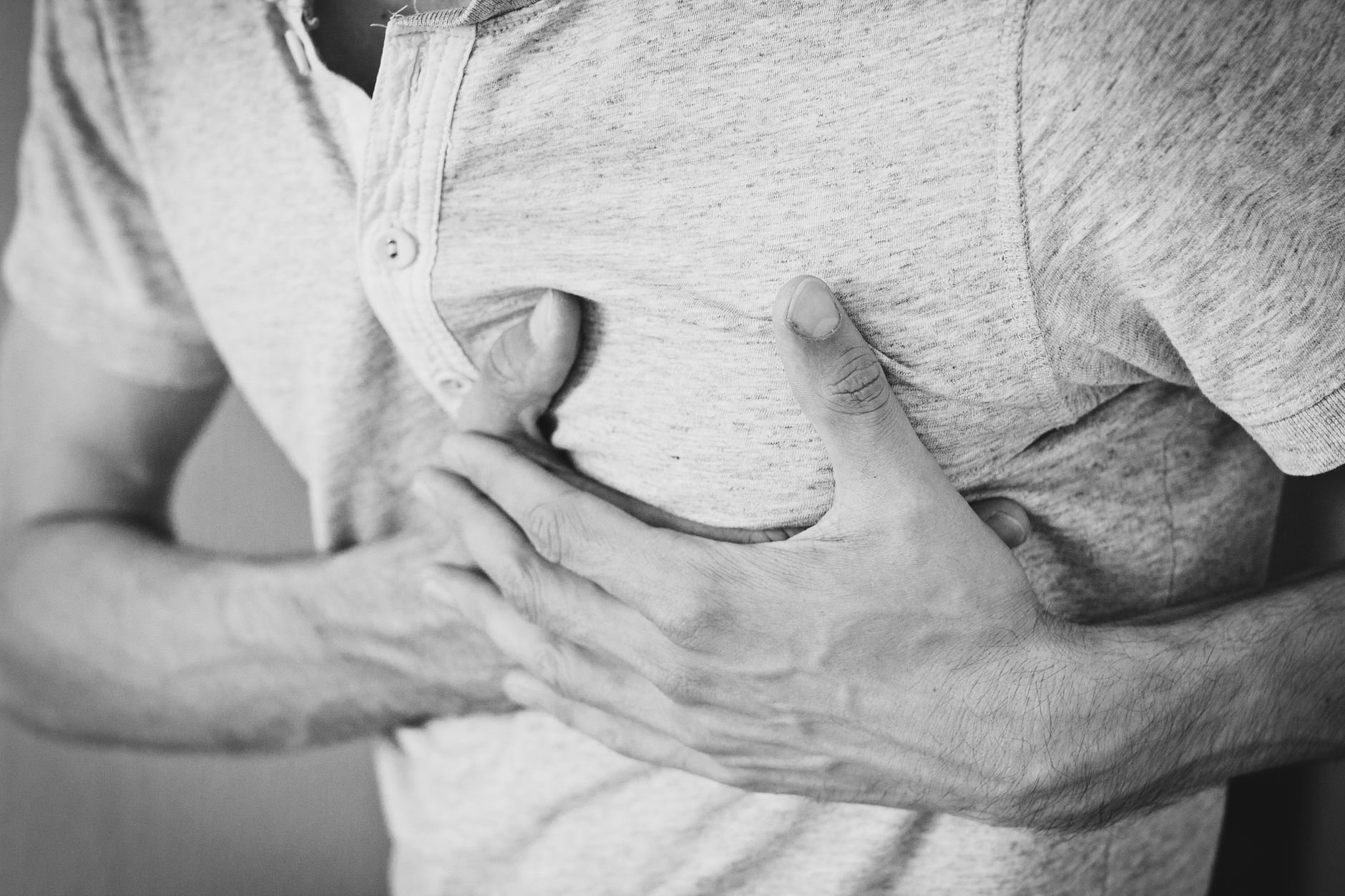
You're sitting on the couch, or driving, or trying to fall asleep. And then your chest tightens. A sharp pull on the left side. Your heart speeds up. You think, this is it, something is really wrong.
Then part of you thinks, wait, is this just anxiety again?
That question, the one you're asking right now, is one of the most common reasons people end up in the ER. And it's also one of the most common reasons people end up in therapy. There's a specific pattern that separates anxiety chest pain from a heart problem, and once you can see it, the fear gets a lot smaller. We'll get to it.
What anxiety chest pain actually feels like
Anxiety chest pain is not vague. It's not "a little tight." For a lot of people, it feels genuinely alarming.
The most common descriptions we hear in session:
- Sharp or stabbing pain: often on the left side, in one specific spot you can point to.
- Tightness or squeezing: like someone is sitting on your chest, or your ribs won't expand.
- A racing or pounding heart: sometimes with skipped beats or a fluttering feeling.
- Shortness of breath: like you can't get a full inhale, no matter how deep you try.
- Tingling or numbness: in your hands, face, or lips, from breathing too fast.
- Panic attack
- A sudden surge of intense fear or discomfort that peaks within 10 minutes and includes physical symptoms like chest pain, racing heart, shortness of breath, dizziness, or a sense of unreality. The symptoms are real. The danger the body is reacting to usually isn't.
Here's the part most articles skip: anxiety chest pain can happen without you feeling anxious first. A lot of clients tell us the chest symptoms came out of nowhere, and then the panic started because they thought they were having a heart attack. That's a normal sequence. Your body can set off the alarm before your mind knows why.
How to tell anxiety chest pain from a heart problem
This is the part everyone wants. There's no perfect at-home test, but there are patterns that help.
Anxiety chest pain tends to:
- Come on suddenly and peak fast: usually within 10 minutes, then start to ease.
- Feel sharp, stabbing, or localized: you can often point to one spot with a finger.
- Change with breathing or movement: it might hurt more when you inhale deeply or press on the area.
- Improve when you calm down: slow breathing, walking, or distraction reduces it.
- Come with other anxiety symptoms: dread, dizziness, tingling, or a sense that something bad is about to happen.
Heart-related chest pain tends to:
- Feel like pressure, heaviness, or squeezing: less like a stab, more like a weight.
- Spread beyond your chest: to your arm (often left), jaw, neck, back, or upper stomach.
- Get worse with physical exertion: climbing stairs, walking uphill, lifting.
- Stay steady or build slowly: not spike and fade within minutes.
- Come with cold sweat, nausea, or a sense of doom that doesn't ease when you breathe.
Two important caveats. First, heart attack symptoms in women are often different: more fatigue, nausea, jaw pain, and back pain, and less of the classic "elephant on my chest." Second, none of this replaces a medical evaluation. If you're not sure, go get checked. Cardiologists we've referred clients to have said the same thing every time: they would rather see a hundred panic attacks than miss one heart problem.
We wrote more about the physical side of panic in panic attacks vs anxiety attacks if you want a closer look at how these episodes build and fade.
Why your body reacts this strongly to a thought
Here's the thing nobody explains well: anxiety chest pain isn't your mind "making up" a symptom. It's your nervous system doing exactly what it evolved to do, at the wrong time.
When your brain detects a threat, real or imagined, it triggers the fight-or-flight response. Adrenaline floods your system. Your heart speeds up to pump blood to your muscles. Your chest muscles tighten so you can brace or run. Your breathing gets shallow and fast, which drops your carbon dioxide levels and causes tingling and dizziness. Your stomach clenches. Your senses sharpen.
All of that is useful if a bear walks into the room. It's not useful when you're trying to fall asleep or answer an email. But your body doesn't know the difference. It runs the same program either way.
The chest pain is a byproduct of the response, not evidence that the response is right. Your body isn't warning you about a heart attack. It's warning you about a threat that isn't actually there.
There's a specific loop that keeps this going, and it's the one we spend a lot of time on in session. You feel a chest sensation. You interpret it as dangerous. That interpretation triggers more adrenaline. More adrenaline causes more chest sensations. Which confirms the danger. Which triggers more adrenaline. Twenty minutes later you're in the ER parking lot.
In our sessions with clients who've been through this cycle, the turning point isn't learning a breathing exercise. It's understanding that the chest sensation is the fear, not the cause of the fear. Once your brain accepts that, the loop starts to break on its own.
What to do in the moment, and what to do next
In the moment, if you've been medically cleared before and you recognize the pattern:
- Slow your exhale: breathe in for 4, out for 6. The long exhale signals your nervous system to stand down.
- Name what's happening: say out loud, "this is anxiety, not a heart attack." Your prefrontal cortex needs to hear it.
- Ground your senses: notice 5 things you can see, 4 you can hear, 3 you can touch. This pulls your attention out of the chest sensation.
- Move a little: walk around, stretch your arms overhead, roll your shoulders. Movement burns off adrenaline.
- Wait it out: the peak of a panic attack passes in about 10 minutes even if you do nothing. Your body cannot maintain that intensity for long.
In the moment, if this is new, severe, or different from what you've felt before, go to the ER. Don't try to talk yourself out of it. A medical evaluation is part of how you get to certainty, and certainty is one of the most powerful anxiety treatments there is.
Next, if you've been medically cleared and this keeps happening, therapy is where the pattern breaks for good. Cognitive Behavioral Therapy (CBT) for panic works by teaching your nervous system, through direct experience, that the physical sensations are not dangerous. That involves noticing the thoughts that spike the fear, testing them against evidence, and gradually exposing yourself to the sensations themselves so they lose their power.
The clients we work with who came in with chest-pain panic usually see a shift within the first 4 to 6 sessions. Not because the sensations disappear right away, but because they stop being scary. And once they stop being scary, they stop showing up as often.
If you want a deeper look at how anxiety physically operates, understanding anxiety symptoms walks through what's happening in the body when the alarm keeps going off. And if you want tools you can use tonight, grounding techniques for anxiety has five that actually work.
We offer online anxiety therapy throughout California, and if you want to talk about whether it's a fit, you can book a free consultation. No pressure. Just a real conversation about what's going on.
You're not broken. Your body is doing something it was built to do. It just needs to learn when to stand down.